
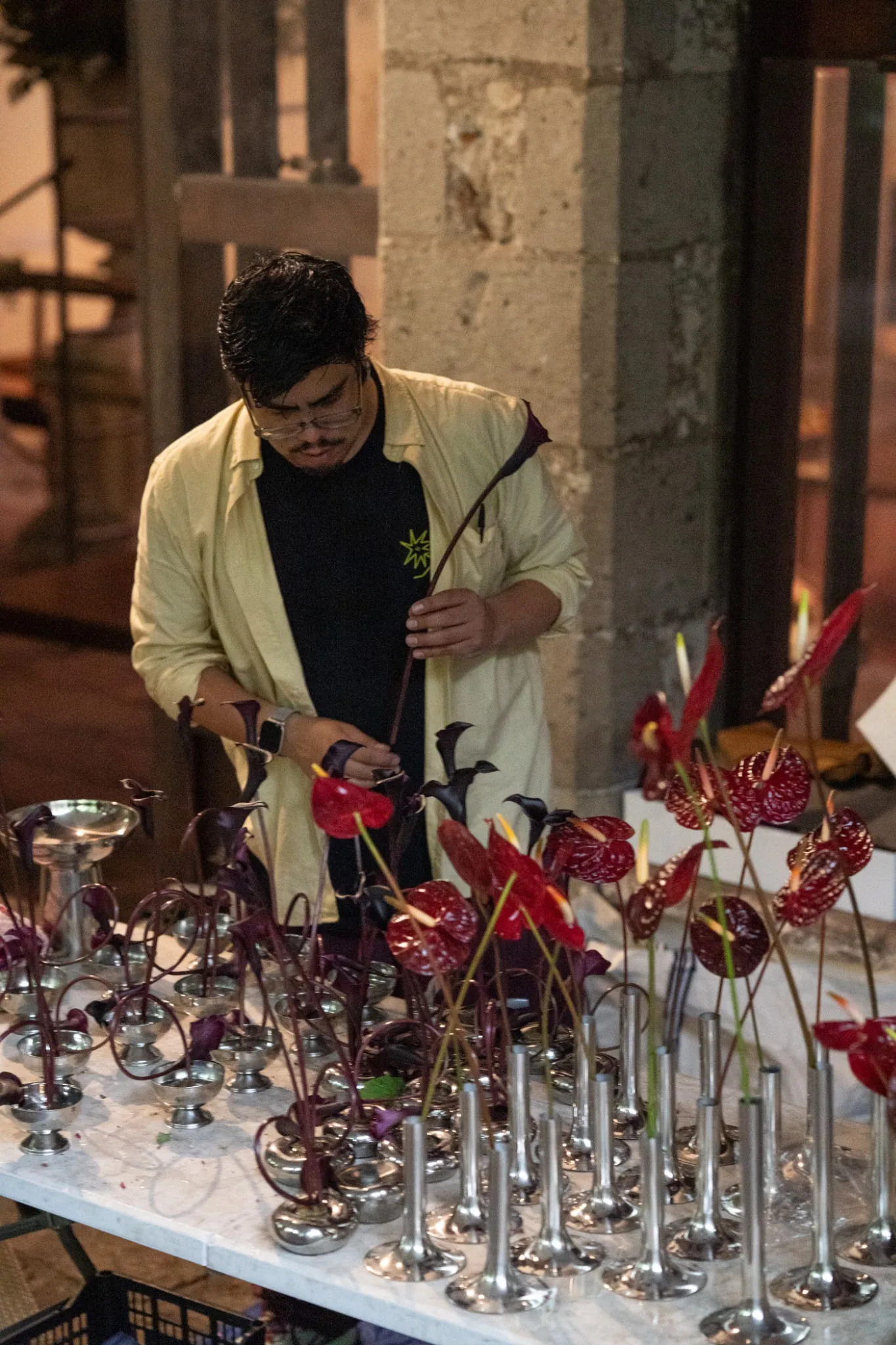
On Color, Imperfection and the Botanical Language of Mexico
The name Xochipilli and Mexican identity
When I first came across Xochipilli, I knew he was a Mexica deity associated with flowers, but I honestly didn’t know much beyond that. At the time, I couldn’t even imagine floral design becoming a career for me. Photography introduced me to a different world of weddings, where design and personal expression had a much bigger role. That experience led me back to flowers and, in a way, to my own roots.
And of course, there’s a little bit of ego involved in naming your studio after the Prince of Flowers. But sometimes you have to imagine yourself becoming something before you actually know how to become it.
I was born in Oaxaca, lived in Puebla, and grew up in Mexico City. I’ve spent years traveling around Mexico photographing weddings. I don’t believe Mexican identity has to be expressed through a specific flower, a clay vessel, or a recognizable traditional reference. My perspective is Mexican because my life is Mexican.
Mexican botany and international influences
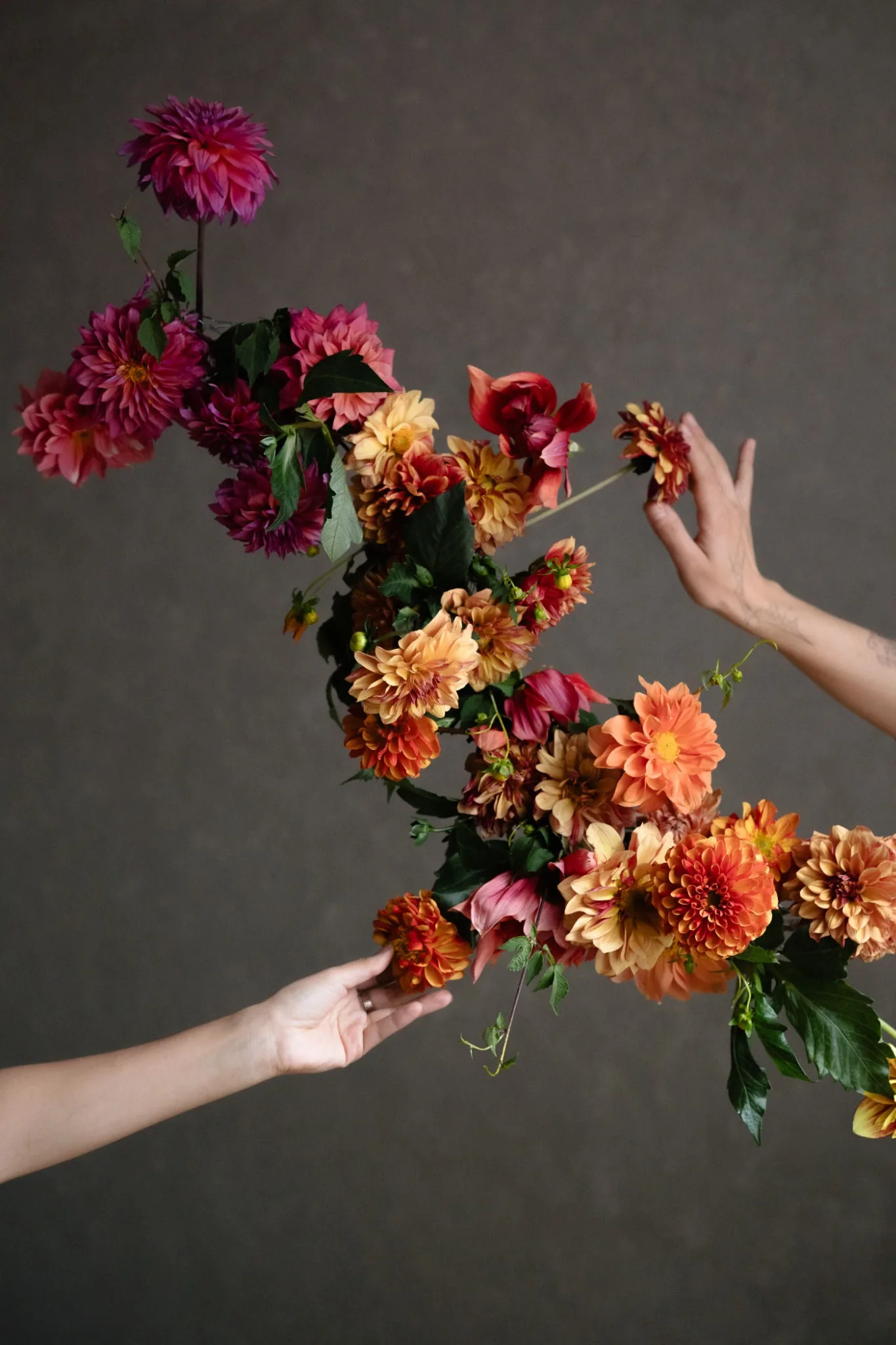
Working with international couples means constantly encountering references from other places, and I don’t necessarily see that as a bad thing. What interests me is how we reinterpret those references through the materials, colors, textures, and possibilities we have here.
Mexico has an extraordinary relationship with flowers. They’re part of our celebrations, traditions, everyday lives, and collective memory. But I don’t think that means we should all be trying to develop one recognizable Mexican floral style. Some couples come to Mexico wanting a celebration that expresses something culturally Mexican. Others simply love the destination and want a wedding that feels like them. Both can lead to interesting work.
I love watching international florists visit the Mercado de Jamaica and get excited about flowers we sometimes walk past without noticing. Sometimes it takes someone else’s curiosity to remind us of what we’ve had in front of us all along.
How do you build a color palette?
I love almost every color. I think that’s obvious if you’ve ever seen the way I dress. But working with color isn’t simply choosing shades that look beautiful together. It’s about proportions, transitions, and what happens when one color exists beside another. Sometimes a tiny amount of a particular shade completely transforms a composition.
I tend to remember places, objects, and even feelings through color. And inspiration doesn’t always come from conventionally beautiful things. I remember watching an interview with the designer behind Charli XCX’s Brat visual identity, where he talked about finding inspiration in something as ordinary as a receipt. I love that idea: inspiration can come from absolutely anywhere.
Mexico City is full of seemingly chaotic color combinations. I like understanding why certain combinations work, even when they feel loud or uncomfortable. For me, color is less about following a formula and more about discovering relationships I hadn’t noticed before.
Has your childlike fascination with color changed?
It’s not almost childlike. It’s completely childlike. I don’t think that fascination ever disappeared. I just developed more tools to understand it.
When I was little, one of my favorite things about starting a new school year was getting new colored pencils and notebooks. I loved choosing the colors of the covers and looking at all those possibilities.
Over the years, I’ve studied color through painting, pigments, design, and ceramics. Ceramics is fascinating because heat and chemistry can transform a glaze into something you couldn’t entirely predict. The child who was excited about colored pencils now has more technical knowledge and more ways to make those instincts tangible. I don’t think I’ve ever outgrown that feeling. I’ve just become better at understanding what to do with it.
How has photography influenced your floral work?
I spent around ten years photographing weddings, so I think about how spaces translate into images almost instinctively. When you’re designing something three-dimensional, you have to understand that many people will eventually experience it through a two-dimensional photograph. But I don’t design everything exclusively for the camera.
Wedding photography teaches you to be versatile: people, food, objects, architecture, movement, intimate moments, and enormous celebrations, sometimes within one day. It taught me that not every corner needs to be filled with flowers. I’d rather understand where flowers can genuinely transform the experience of a space.
And flowers are unpredictable. You can plan precisely, and then a stem bends or a flower opens differently than you expected. Sometimes the flower itself changes the decision you were about to make. Good floral design isn’t about covering every surface with flowers. It’s about understanding where they can make a difference.
How do you balance planning with letting go of control?
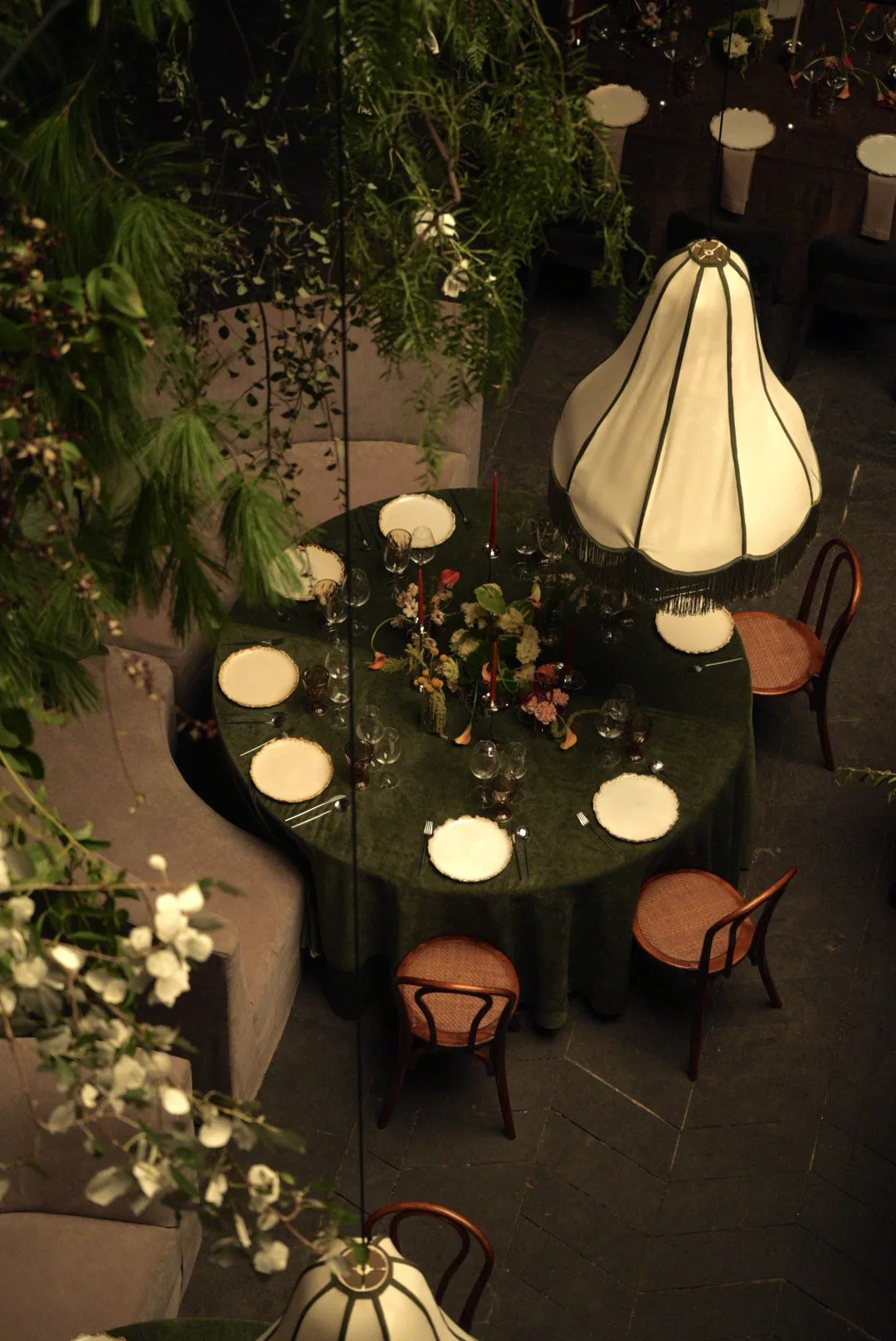
I’m an overthinker. I can spend an enormous amount of time imagining how something should look before we begin. But eventually you have to accept that the perfect piece you imagined doesn’t actually exist. What exists is the piece you’re making, with the flowers you have and the circumstances of that day.
I see this in students too. Sometimes they’re so concerned about making the best arrangement in the room that they forget they’re supposed to be learning. We’ve all made questionable arrangements. Some of us still do occasionally.
Events involve so many people and moving parts that trying to control everything can make manageable problems unnecessarily complicated. Planning is essential, but creativity also requires knowing when to stop forcing reality to match the image in your head.
I think that’s why I encourage students to play rather than compete over whose arrangement looks best. Making a piece that doesn’t work is not the end of the exercise; sometimes it’s the part that teaches you the most. And in an event, when dozens of decisions and people are involved, the ability to adapt is often more useful than the fantasy of perfect control.
What role does imperfection play in your work?
Flowers are already considered beautiful. That’s almost the problem. Sometimes we’re so focused on presenting them in the most conventionally beautiful way that we forget other possibilities.
I’m interested in the crooked stem, the strange shape, the half-open flower, or the one doing something different from all the others. There’s something very human about that. And creativity shouldn’t depend on the most expensive materials. You can make something interesting with backyard plants, an oddly colored plastic bag, or something never intended for an arrangement. You could probably even experiment with a fish from your refrigerator. Just wash everything afterward, and please don’t use your floral scissors to cut the fish.
What matters is seeing something differently and leaving a little bit of who we are in what we create.
How do you work with couples who bring specific references?
Some clients come because they’ve seen something we’ve already made and want something similar. Others are interested in what we might imagine for them. Both are valid, but the second gives us a different opportunity.
A couple might request an entirely white palette. Then we hear their story and imagine another direction that feels more personal. I won’t tell them their references are wrong. I’ll show you what you asked for, but I’ll also show you what I imagined after listening to your story.
We once discussed creating a wedding that felt like the bride’s grandmother’s house. But what does a grandmother’s house actually look like? We all have associations, yet the details that make your grandmother’s home meaningful differ from mine. That’s where the design begins: not with being unusual for its own sake, but with making a celebration belong to the people experiencing it.
Even when two couples choose similar flowers or the same kinds of vessels, the result can feel entirely different once you understand the memories and emotions behind their choices. That’s what makes a design personal to me: not inventing something strange for the sake of novelty, but recognizing the details that belong to that particular story.
What do you think about Pinterest, Instagram, and trends?
Social media can be wonderful. Algorithms introduce you to things you might never discover on your own. But we need to understand why something appeals to us. Is it the design, the atmosphere, the luxury, or the fact that everyone seems to be having a wonderful time? There’s a difference between seeing something beautiful and understanding why you find it beautiful.
Social media can also be exhausting. Sometimes I finally have a free weekend, open Instagram, see another florist producing an enormous wedding, and suddenly wonder whether I should be working too. Which is ridiculous, because I was perfectly happy five minutes earlier.
The challenge is staying curious without letting trends dictate your decisions. Just because silver is fashionable doesn’t mean every couple needs silver. Sometimes their personality is much more gold.
I want to remain aware of what’s happening visually without letting an algorithm tell me what I should want. That goes for my clients too. A fashionable material or color isn’t necessarily the one that best expresses who they are. Sometimes the most interesting choice is the one that doesn’t need to announce that it’s current.
How do you approach seasonality and specific flower requests?
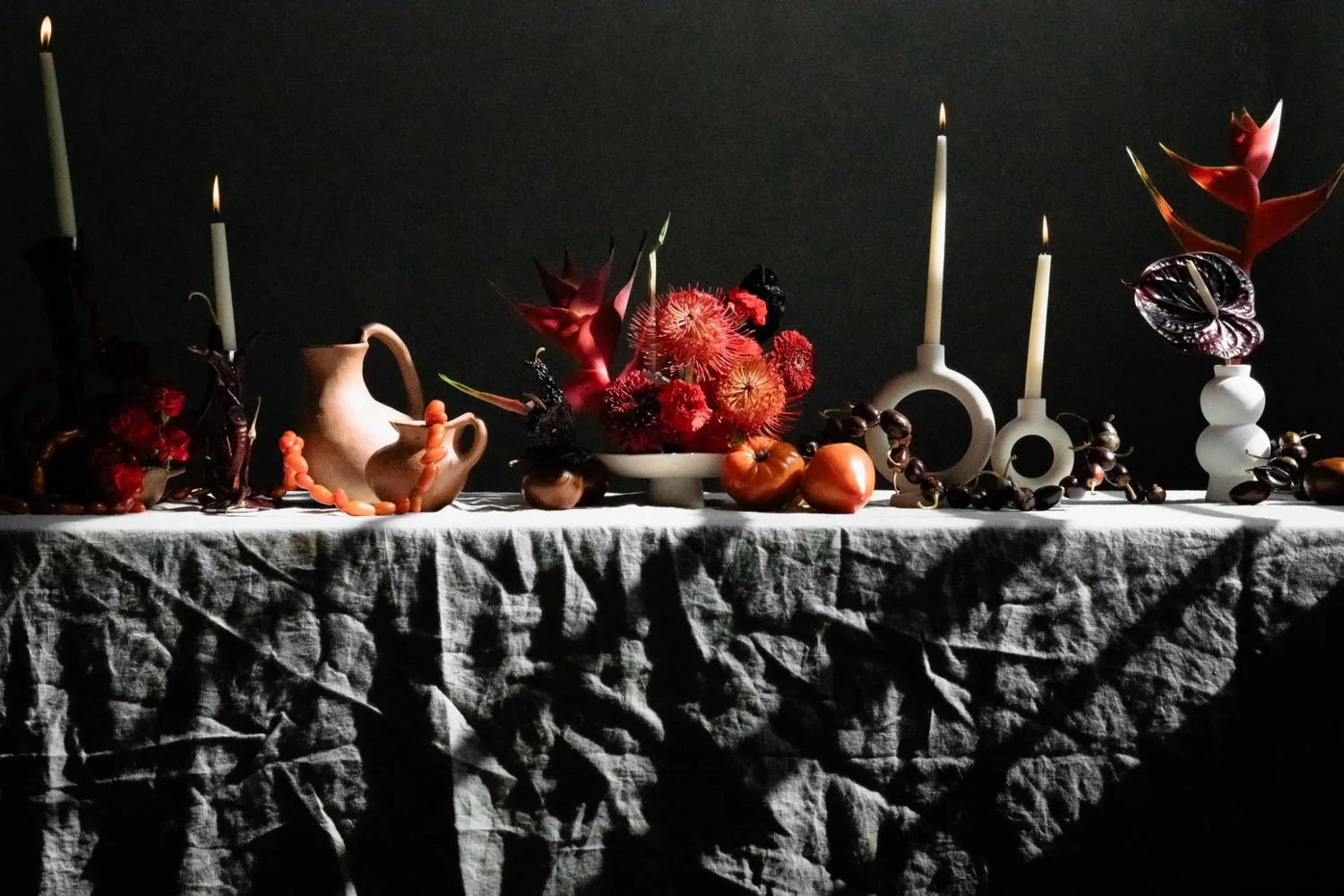
I try to be transparent about what’s available and what we can realistically promise. I love working with seasonal flowers and local materials whenever possible, and avoiding unnecessary imports or higher-impact production. But limitations can also be creatively exciting. Not being able to source a flower can force you to discover another possibility.
I don’t want to guarantee something I’m not sure we can deliver. That’s not good service; that’s creating a problem later.
And my relationship with nature goes beyond flowers we buy. Sometimes the foliage and climbing vines in our arrangements come directly from my own garden. I love that something growing outside my home can become part of a wedding or installation. Beautiful materials aren’t always things we need to search for. Sometimes they’re already growing right beside us.
I think saying yes to every request can actually be a disservice. If a flower isn’t in season or I can’t confidently source it, I’d rather explain that from the beginning and look for another way to achieve the feeling the client wants. A limitation can become an invitation to invent something better.
What does sustainability mean to you?
For me, sustainability has to begin with the people behind the materials. We talk a lot about whether something is biodegradable or recyclable, and those conversations matter. But I think we sometimes forget to ask where our materials come from, who produces them, and under what conditions.
Flowers don’t magically appear in a market. There are growers, transporters, vendors, designers, and entire teams of people involved, often working incredibly long hours under difficult circumstances. And I find it particularly uncomfortable when people with significant resources try to negotiate already struggling growers down to the lowest possible price, just to improve their own margins. If we’re going to talk about ethics, we have to talk about how we treat people, not only what happens to the materials afterward.
We also have to be careful about treating sustainability as a label. For example, certain floral foams are marketed as biodegradable, but that doesn’t necessarily mean they will break down under the conditions in which they’re actually discarded. You can find piles of foam with stems still stuck in them, and not nearly enough conversation about how these products should be disposed of. Simply choosing not to use foam doesn’t automatically make an entire business sustainable either.
There’s packaging, transportation, waste, labor, and so much more to consider. I’ve worked on film sets where the amount of disposable material and food waste for a crew of a hundred people was astonishing. Every creative industry has contradictions. I don’t think we can pretend to be perfectly ethical in everything we do, but we can keep questioning our decisions and taking responsibility for them.
A floral installation doesn’t magically appear in a room looking beautiful. There are so many hands involved. And I think we need to care about those hands as much as we care about the flowers.
Can luxury and sustainability coexist?
There’s a real contradiction there, and I don’t want to pretend otherwise. In many Western contexts, luxury is associated with abundance: more flowers, bigger installations, more everything.
I understand the appeal. I love abundance too. We create enormous, exuberant installations, so I’m not arguing everything should become minimalist. But we should question whether quantity is always what makes something luxurious.
Sometimes a carefully considered composition is more extraordinary than a room full of flowers that have no real reason to be there. I’d love for people to value design, craftsmanship, and thoughtful decisions as much as sheer volume. Perhaps the most luxurious thing we can offer isn’t unlimited abundance, but the ability to make thoughtful choices.
I’m not against abundance. I genuinely love exuberant, monumental work. What I question is abundance without intention. If a room is filled with flowers, I want those flowers to be doing something: changing the scale, directing the eye, creating an emotion, or transforming the way people experience the space.
Is there a Latin American floral identity?
Latin America has an extraordinary diversity of visual languages, and I wouldn’t reduce them to one aesthetic. Every country has its own history, social context, politics, materials, and traditions. All of those influence how people create.
I taught a workshop in Brazil about a year ago and was fascinated by the orchids and flowers available there. Materials that seem ordinary and inexpensive in one country can be exotic and expensive somewhere else. That changes how we value them.
Sometimes we overlook the beauty around us because we’re used to seeing it. Perhaps developing our own visual languages isn’t about finding something that makes us all look alike, but recognizing the value of everything that makes us different.
In Brazil, for example, I was fascinated by materials that local designers might encounter all the time. And I know the reverse happens when visitors come to Mexico and get excited about flowers we barely notice. That difference in familiarity is a reminder that no one country or aesthetic can stand in for the creative experiences of an entire region.
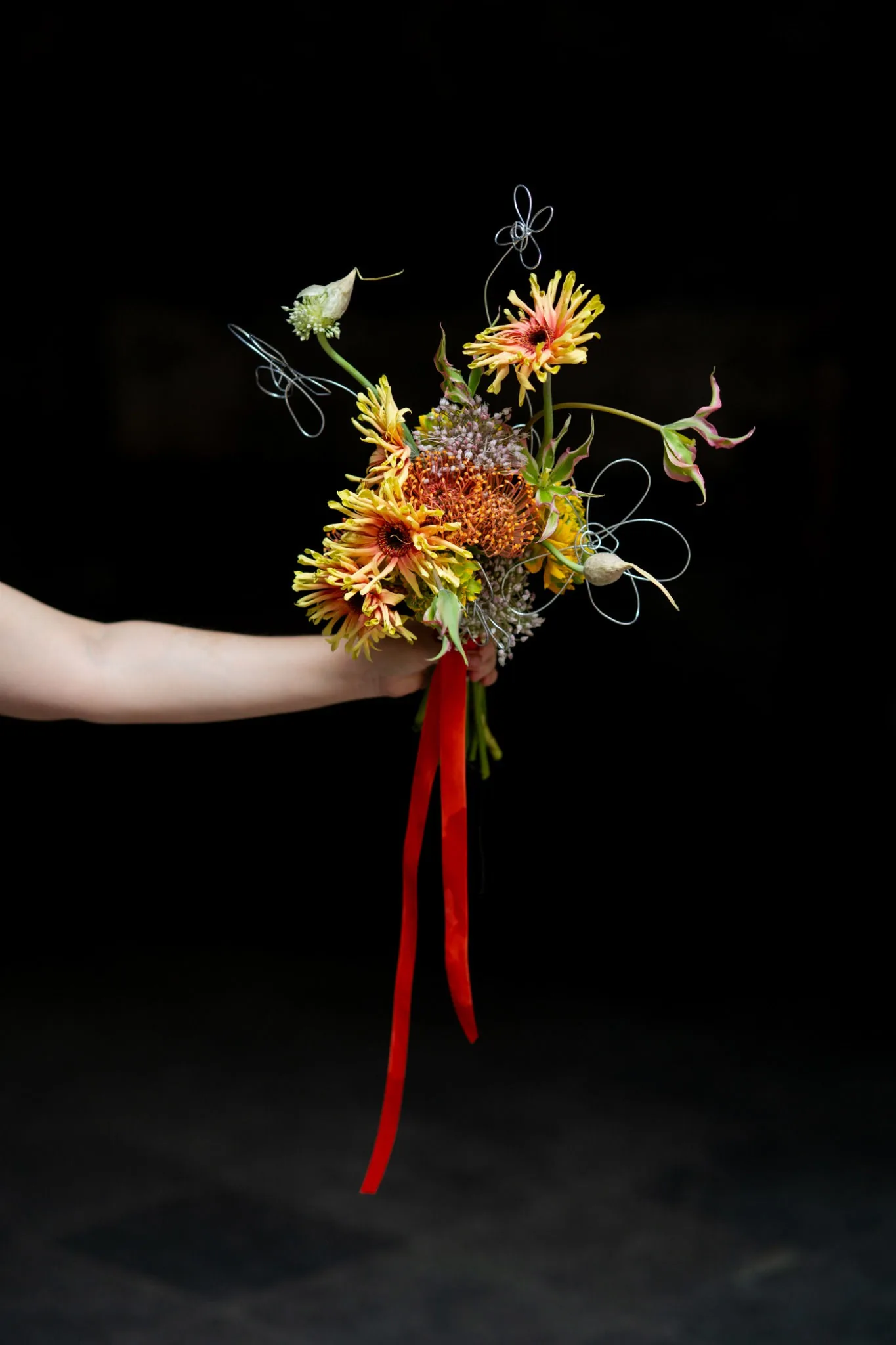
How do we avoid reducing Latin American design to stereotypes?
I might not be the best person to answer this question, because there’s actually quite a lot of folklore in my own work. I love working with color, traditional references, and elements that are deeply connected to Mexican culture. But I don’t think our identity should be reduced to those things.
I completely understand when international couples come to Mexico and genuinely want to celebrate aspects of our culture. I think it’s wonderful when that comes from a place of curiosity and respect, and when they want to create space for Mexican traditions and craftsmanship to be appreciated by their guests.
But I’ve also noticed that this expectation is gradually changing. I’m seeing fewer international weddings built entirely around a recognizable Mexican theme, and more couples who understand that there’s an incredibly strong creative industry here. And let’s be honest, producing a wedding in Mexico can also be significantly more affordable than in other countries. That creates opportunities for couples to explore ideas that might be much more difficult to achieve elsewhere. Whether we see that as entirely positive or recognize its complexities, I think it has contributed to a much more diverse creative landscape.
We’re no longer necessarily expected to create something that looks traditionally Mexican just because the wedding is taking place in Mexico. And that freedom matters: Mexican designers shouldn’t have to constantly prove where they’re from by repeating the same visual symbols. Our work can be shaped by our culture without having to illustrate it literally every time.
I think we can celebrate Frida Kahlo and recognize her extraordinary importance without expecting her to represent the entire spectrum of Mexican creativity. There are so many fascinating contemporary artists whose work deserves more attention. I’m thinking about people like Ramiro González, Ranchito, Perla Camacho, or Montserrat Piña Bennets. Their practices offer different ways of exploring materials, objects, identity, and the world around us, reminding us that contemporary Mexican art is far more diverse than the familiar imagery often associated with our culture.
What excites me about discovering artists like them is realizing how many different ways there are to create from a Mexican perspective without necessarily reproducing the symbols that people immediately associate with Mexico. And I think we should be much more curious about those voices, especially the ones that don’t always receive the same international visibility.
There are so many different kinds of Mexican people, with different experiences, interests, and ways of seeing the world. We can be experimental, conceptual, playful, provocative, or anything else we want to be. We don’t need to share the same aesthetic to share an identity.
Does moving between weddings, brands, and editorials keep things experimental?
They’re completely different kinds of clients, and they approach creativity in different ways. Moving between brands, weddings, editorials, and teaching expands not only what I can create, but what I’m capable of imagining.
Editorials are where I feel the greatest freedom to experiment. We can make really strange things. With brands, I love the challenge of translating a visual identity into a floral language. And weddings offer another kind of freedom: in one project we might create an intimate bridal bouquet, an elaborate bar arrangement, and an enormous installation that transforms a space.
I enjoy moving between those scales and ways of thinking. Each discipline feeds the others, and that keeps my curiosity alive.
I don’t think one of these worlds is automatically more creative than another. An editorial can let you do something wonderfully strange, but a corporate project can challenge you to turn a brand’s identity into a physical experience, and a wedding can ask you to move between the most intimate and the most monumental scales in a single day. Those different challenges change the way I think, even before they change the work itself.
Can good taste be taught?
Well, I think the first question should be: what does good taste mean to you?
I’m not interested in having people come to my classes and leave with exactly the same vision I have. I don’t expect them to find the same things beautiful, or to become another version of me simply because they believe I must be right about everything. We might share certain tastes, and that’s great. But that’s not the point of teaching.
Sometimes I see students doing something that’s technically incorrect, and of course, there are things I can help them improve. But other times, I see something technically imperfect that tells me much more about the person making it. I can recognize something in that decision that might eventually become part of their own visual identity.
And I think there’s a huge responsibility in teaching: learning to separate your personal preferences and convictions from the vision of someone who’s still discovering their own. Students need technical guidance, absolutely. But they also need someone who can help them trust what they’re seeing, understand why they’re drawn to certain things, and figure out how to refine those instincts without losing them.
Of course, there’s also the question of who they want to work with. Understanding your client’s taste doesn’t necessarily mean deciding whether they have good or bad taste. It means understanding their perspective and the kind of work you want to create together.
So, can you teach someone good taste? Yes, absolutely. But again, whose taste are we talking about? I think we’re constantly educating our eyes through what we consume: Instagram, TikTok, fashion, art, everything around us. But I also like to think that we develop our taste through the things we consciously choose not to consume. The trends we decide not to follow.
Take Labubu, for example. Do I want one because I find it so horribly ugly that it’s actually beautiful? Or do I want one because everyone else has one, and I want people to know that I have one too? And yes, obviously I have my own Labubu. Those are two very different motivations, and owning one doesn’t mean you should stop questioning why you wanted it.
I think understanding why we like something, and whether that desire actually belongs to us, is much more interesting than trying to establish some universal definition of good taste. And it’s certainly not something you learn in a single class. Developing your eye is something you continue doing throughout your life.
Has teaching changed your own assumptions?
Absolutely. I like giving students freedom to build their own palettes within a controlled selection of colors. I know those colors can work together, but students regularly choose combinations that weren’t even on my radar.
I don’t necessarily think their perspective is more innovative than mine. Sometimes it’s simply the perspective of someone who has lived a completely different life. I love that.
We should question rules and techniques constantly. I don’t teach recipes. I want students to understand how to construct what they’re imagining: which steps help, which decisions strengthen a piece, and which elements communicate something they never intended. Technique should help express an idea, not dictate what that idea must be. And as a teacher, I learn from their decisions too.
I don’t teach people to follow a recipe. I want them to understand how to construct whatever they’re imagining. What steps might help them get there? Which decisions make the piece stronger? Which elements are unnecessary, or perhaps communicating something they never intended? Technique should help you express an idea, not dictate what that idea has to be. Teaching is a balance between offering structure and allowing someone the freedom to solve a problem in a way that might never have occurred to me.
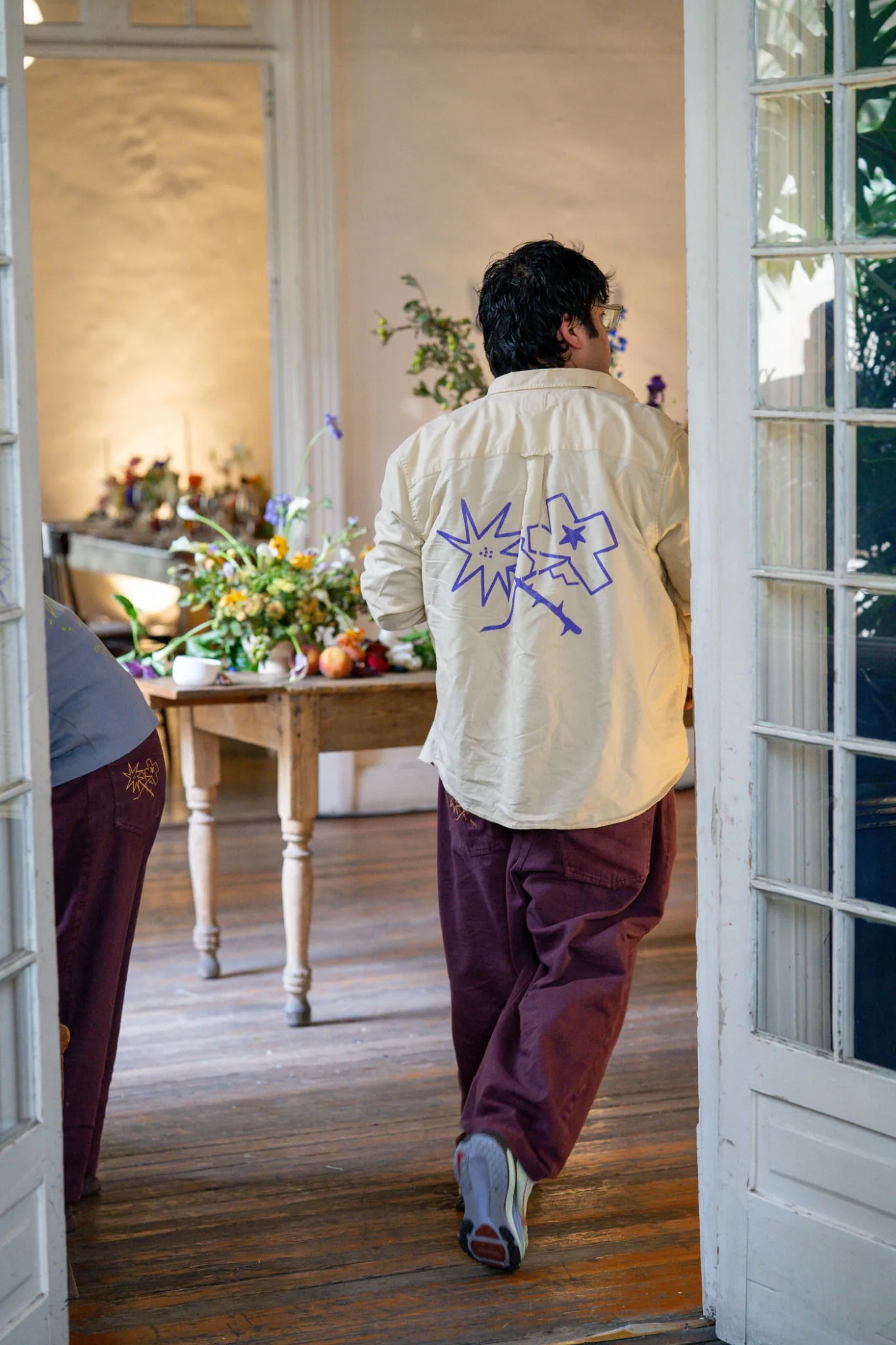
Does the ephemeral nature of flowers make your work more meaningful?
It can be heartbreaking. Sometimes you arrive to dismantle an installation and everything looks exactly as beautiful as when you left it. Now you’re there to take it apart.
What helps is knowing how much care went into bringing those flowers to that moment. We usually buy roses at least a week before a wedding so they can be in full bloom for the celebration. I want people to experience how extraordinary it is to see something bloom. Afterward, those flowers have fulfilled a particular purpose.
What we create will never happen exactly the same way again: not with the same people, flowers, or atmosphere. That includes the experience of making it. I don’t want my team to be machines reproducing arrangements. I want us to enjoy ourselves, play with flowers, and do something we love, even with deadlines and all the pressures of an event.
It’s not just that the installation will never exist again. It’s that the entire experience of creating it will never exist in quite the same way either.
And that last part matters to me just as much as the final installation. I don’t want my team to feel like machines reproducing floral arrangements. I want us to be a group of people enjoying ourselves, playing with flowers, and doing something we genuinely love: designing. Of course, we’re working within someone else’s vision, with deadlines and all the pressures that come with producing an event. It’s not always as relaxing as the idea of playing with flowers might suggest. But there’s something wonderful about having the opportunity to work with something so inherently beautiful.
When does photography become part of the artwork?
I think about photography when I’m designing, and I often photograph the work myself. The funny thing is that when I have time to photograph an installation, the lighting usually isn’t finished, the candles aren’t lit, and the atmosphere hasn’t fully arrived. But I still make a record.
After years of photographing weddings, I instinctively create little photographic stories of what we’re making, how we’re making it, and how the team is doing. I’ve always loved experimenting with shutter speed: making the sensation of rushing physically visible.
With slow shutter speeds and intentional camera movement, flowers dissolve into streaks of color. The photograph stops being about a flower and becomes about relationships between color, shape, movement, and the surrounding composition. It’s like removing the obvious first layer of beauty to discover something else.
Sometimes we print those images, and a physical photograph changes how we remember the arrangement. The flowers are gone, but the photograph allows me to keep discovering them.
What I love about those slow-shutter photographs is that they almost erase the first layer of beauty. The flower stops being the obvious subject, and suddenly the relationships between colors, movement, shapes, and the rest of the space become more important. Sometimes we print those photographs, and seeing one as a physical object changes the way I remember the original arrangement. The flowers are gone, but the photograph allows me to keep discovering them.
Is there a flower or material you learned to appreciate differently?
I constantly challenge myself to work with flowers I don’t particularly like. I think you need problems to stay creative. If you always use the same flowers and colors, even experimentally, you eventually find yourself in a comfort zone. There’s nothing wrong with that, but I don’t want to stay there.
I like constantly moving and rediscovering myself through what I make. I’m a slightly different person every year. Not entirely different, but not exactly who I was twelve months ago. If I’ve changed, my work should be free to change with me.
So yes, there are flowers I hate. Colors I hate, too. But my personal preferences shouldn’t define the limits of my work. Sometimes those strong opinions are useful because they give me something to question.
I also feel like I’m a slightly different person every year. Not necessarily a completely different person, but certainly not exactly who I was twelve months ago. If I’ve changed, then my work should have the freedom to change with me. I have to keep asking myself what design means to the person I am now, rather than simply repeating what felt right to an earlier version of myself.
What do you refuse to do, even if it might be commercially successful?
I could give you a very romantic answer to this question, but the reality is that we’re also a business. And sometimes, running a business means compromising on certain things so that you can keep generating income, supporting your team, and taking Xochipilli somewhere better.
We’re not always creating something completely unique or experimental. Sometimes we simply reproduce a style or an arrangement that a client has requested. And I’m okay admitting that.
What we don’t necessarily do is share all of that work on social media. Not because I’m embarrassed by it, but because I’m conscious of what I want people to associate with our studio. Sometimes we take on those projects for purely financial reasons. Other times, they’re for wonderful clients with whom we’ve created very interesting things, but who occasionally need something much simpler. And we’re perfectly capable of providing that too.
I think there’s a difference between the work you’re willing to do and the work you want to become known for.
But if we’re talking about something I genuinely refuse to compromise on, it would be floral foam. It’s not a material I feel comfortable using, and I believe there are so many ways to solve the same design challenges with mechanics that are less harmful and, in many cases, reusable. Of course, some things are more difficult without floral foam. I’m very transparent about that with clients. There are certain things we might need to approach differently, and occasionally things we simply can’t promise.
The same goes for the lifespan of flowers. Sometimes people expect flowers to last forever, but they’re living materials, and their environment makes an enormous difference. The conditions in my studio, where it’s cool and humid, are completely different from those in a café where bread is being baked all day. Obviously, the flowers aren’t going to behave or last the same way.
So I think my boundaries are less about refusing to make something that doesn’t perfectly match my personal taste, and more about being honest about the materials we use, the conditions we work within, and what we can realistically deliver. I want Xochipilli to keep growing, and I understand that growth requires flexibility. But there are still certain decisions I want to be able to stand behind.
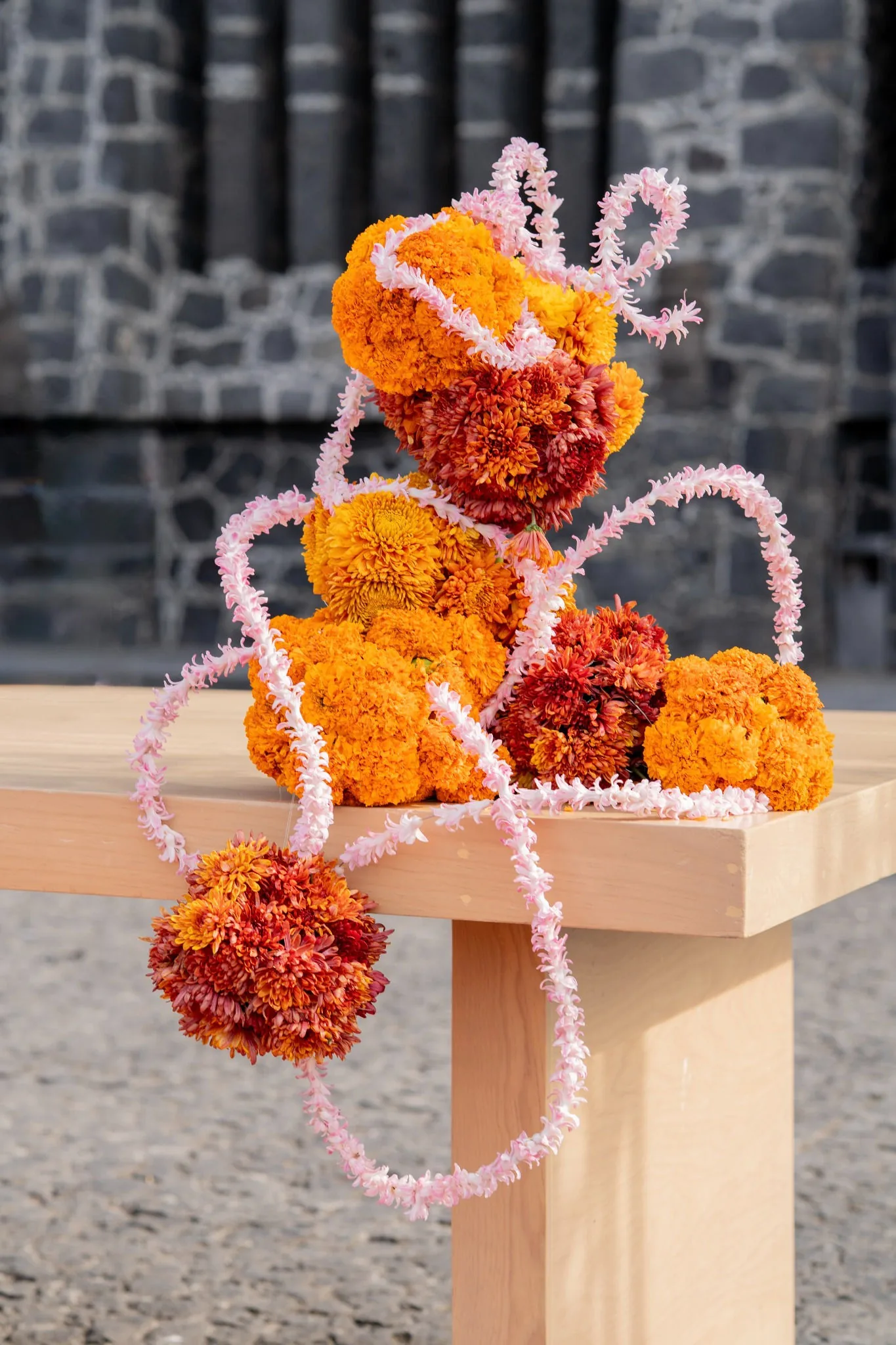
If you could make one project without commercial limitations, what would it be?
I think if I had that opportunity, I would want to work with something much more valuable than flowers: time.
I’d love to really explore a single flower. Not just how I could use it in an arrangement, but its weight, dimensions, structure, and nature. Then perhaps reinterpret what I discovered through ceramics, painting, photography, or another floral composition.
Quite often I’ll make an arrangement, come back the next day, and immediately want to change everything. Sometimes it gets better, sometimes worse, and sometimes I want to start over. It becomes this enormous cycle of experimentation, and I love that.
Or take orange. How many possibilities are there within a single color? I genuinely think I could spend years experimenting with orange alone.
Perhaps my dream project wouldn’t be enormous or spectacular. It would be having the freedom to take one flower, one color, or one idea and explore it as far as my curiosity could take me. Without deadlines, without needing a final result, and without feeling something must be finished simply because it’s time to move on.
Because so much of what we do professionally is shaped by deadlines, expectations, and the need to make decisions quickly. And although I love that part of my work, I sometimes wonder what I might discover if I could simply keep looking.
I think that’s the greatest luxury I could imagine as a creative person: having enough time to keep discovering what else something could become.


