
By UNICO Love Club
There is an interesting contradiction at the heart of contemporary destination weddings.
Couples are travelling farther than ever before, crossing oceans in search of places that promise authenticity, intimacy and a sense of occasion that cannot be recreated at home. Yet the farther they travel, the more similar many celebrations have become. Beaches are selected because they resemble the beaches that came before them. Hotels are chosen because they have perfected a recognizable language of luxury or all-inclusive. Floral designs, ceremony layouts and even guest experiences often appear as though they have been lifted from the same carefully curated collection of images circulating endlessly across social media.
The destinations themselves become almost interchangeable.
One could remove the logo from the welcome bag, change the colour of the sea ever so slightly, and many guests would struggle to remember whether they had travelled to Jamaica, Mexico, the Dominican Republic or another celebrated corner of the Caribbean. They would remember that it was beautiful. They might remember the sunset. They would certainly remember the wedding.
But would they remember the place?
It is a question that has become increasingly relevant as destination weddings evolve. More couples are beginning to ask not simply where they should gather the people they love, but why they should choose one destination over another. Beauty alone is no longer sufficient. A beach may provide a magnificent ceremony backdrop, but a marriage deserves more than scenery. It deserves a setting with character, memory, history and a culture generous enough to welcome strangers into its own traditions.
This is where Trinidad and Tobago quietly distinguishes itself. Not because it is more beautiful than the rest of the Caribbean. Beauty has never been in short supply across these islands.
Rather, because Trinidad and Tobago has never allowed itself to become a simplified version of the Caribbean. It has resisted the temptation to reduce its identity to turquoise water and palm trees, choosing instead to remain wonderfully, unapologetically complex. Perhaps that is why it remains one of the region’s most fascinating places to discover. And perhaps it is precisely why it deserves to be considered among its most extraordinary places to marry.
The twin-island republic occupies an unusual position, both geographically and culturally. Situated just off the northeastern coast of South America, Trinidad and Tobago belongs unmistakably to the Caribbean while simultaneously reflecting centuries of exchange with Latin America, Europe, Africa, India, China and the Middle East. Few countries in the region embody cultural convergence so visibly. African traditions, the legacy of Indian indentureship, European colonial history, Indigenous heritage, Chinese migration and Syrian-Lebanese entrepreneurship have not remained isolated influences. Over generations they have intertwined, producing a society whose identity cannot be explained through a single narrative.
It is this complexity that gives the islands their remarkable sense of place.
One notices it immediately, although rarely all at once.
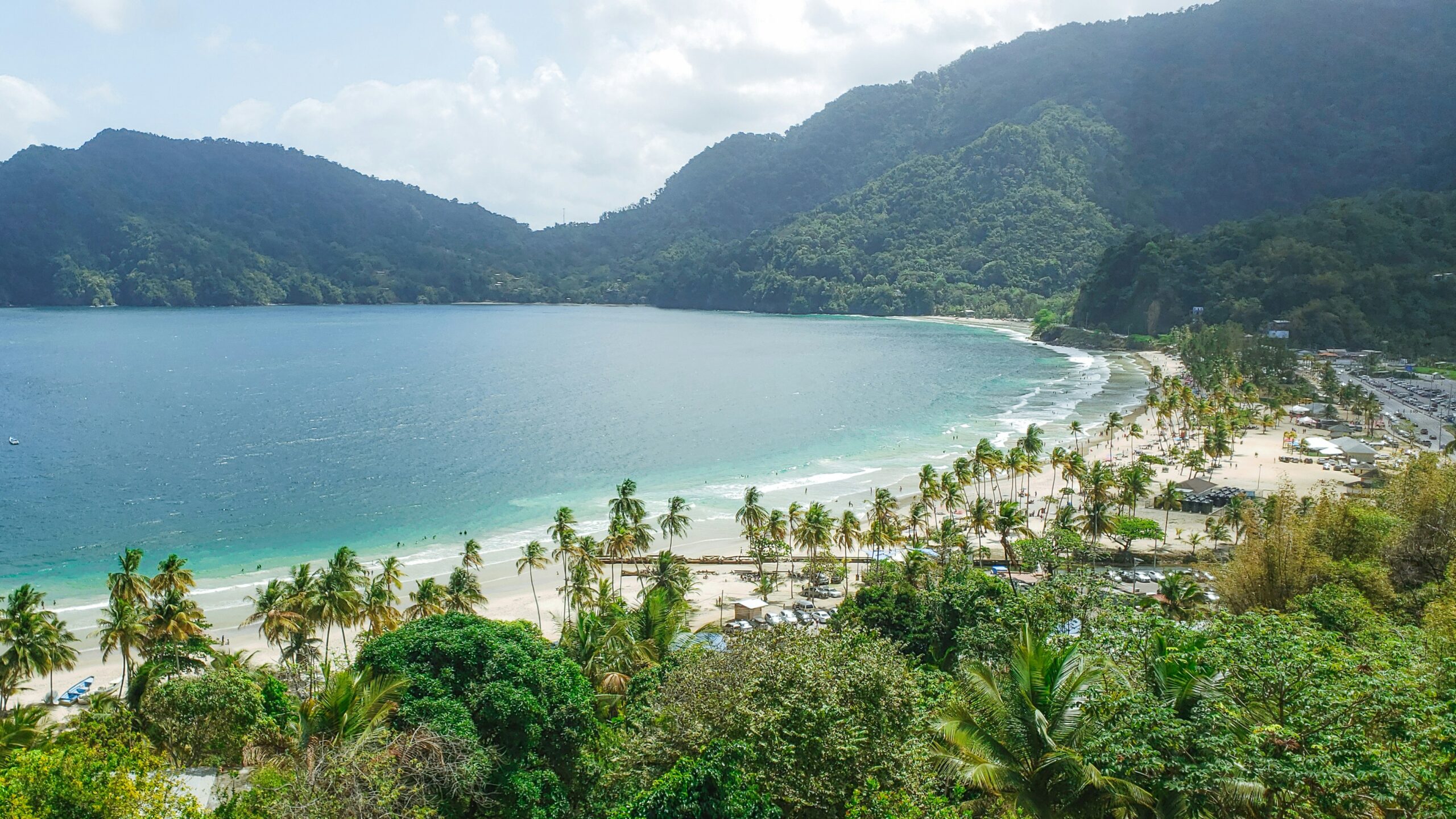
It appears in Port of Spain, where colonial architecture stands comfortably beside modern creative spaces, lively markets and neighbourhood restaurants whose menus reveal the country’s extraordinary cultural inheritance. It continues along Trinidad’s Northern Range, where winding roads climb into rainforest before descending dramatically towards secluded bays and fishing villages. It reveals itself in the wetlands of Caroni, where scarlet ibises return at dusk in one of the Caribbean’s most spectacular wildlife displays, and in Grande Rivière, where leatherback turtles have returned for generations to nest on beaches protected through community-led conservation.
Crossing to Tobago introduces another rhythm entirely. If Trinidad feels energetic, layered and cosmopolitan, Tobago is contemplative. Villages such as Castara and Speyside move according to the sea rather than the clock. Fishermen still launch their boats at dawn, conversations unfold unhurriedly beneath verandas, and visitors quickly discover that hospitality here is measured less by efficiency than by genuine human warmth.
The island possesses some of the Caribbean’s most remarkable coastal landscapes. Pigeon Point Heritage Park is perhaps the most recognizable, celebrated for its sweeping shoreline and iconic jetty, yet Tobago’s true magic often lies elsewhere. Englishman’s Bay remains embraced by dense rainforest, its crescent of sand feeling almost untouched by the pressures of modern tourism. The Main Ridge Forest Reserve, established in 1776 and widely recognized as the oldest legally protected rainforest reserve in the Western Hemisphere, reminds visitors that conservation has long been woven into Tobago’s identity rather than introduced as a contemporary trend.
What becomes increasingly apparent while travelling through the islands is that Trinidad and Tobago asks something different of its visitors. It asks them to participate.
This philosophy perhaps finds its greatest expression in Carnival, an event so internationally recognized that it has become almost impossible to discuss Trinidad without mentioning it. Yet Carnival is also one of the Caribbean’s most misunderstood cultural traditions. Outside the country, it is frequently reduced to its most photogenic elements: elaborate costumes, vibrant colors and exuberant dancing. The spectacle is undeniable, but to understand Carnival solely through its visual language is to overlook the profound historical and cultural forces that shaped it.
Carnival emerged from centuries of social transformation. Influenced by French masquerade traditions and profoundly reshaped following emancipation, it became an extraordinary expression of resilience, creativity and collective identity. Music, costume-making, satire, craftsmanship and community converged into something far greater than an annual celebration. Carnival became a living conversation between history and the present, reminding every generation that celebration itself can be an act of cultural expression.
From this same cultural landscape emerged one of Trinidad and Tobago’s greatest contributions to world music: the steelpan.
Fashioned from discarded industrial oil drums during the twentieth century, the steelpan represents one of history’s most remarkable acts of creative reinvention. Few instruments possess such symbolic power. Born from limitation, it became capable of astonishing sophistication, accompanying everything from classical orchestras to intimate wedding ceremonies. To hear a skilled steel orchestra perform beneath the evening sky is not simply to enjoy beautiful music. It is to experience an instrument that embodies the country’s extraordinary ability to transform history into art.
The same spirit of transformation extends naturally to the table.
Trinidad and Tobago’s cuisine cannot be understood as a collection of recipes. It is, instead, an archive of migration. Doubles, perhaps the country’s most beloved street food, tells the story of Indian communities whose culinary traditions gradually became inseparable from Trinidadian identity. Callaloo reflects West African influences. Pelau, roti, curry crab and dumplings, fresh seafood, tropical fruit, locally cultivated cocoa and the internationally celebrated Angostura bitters all speak to generations of exchange between cultures that never simply coexisted but continuously reshaped one another.
Eating here is not merely pleasurable. It is educational. Each meal quietly reveals another chapter in the country’s history. Equally revealing is a Trinidadian idea for which there is no perfect translation: the lime.
To lime is to spend time together without urgency or expectation. Friends gather. Food appears. Music begins almost incidentally. Conversations drift effortlessly from one subject to another. Children wander between generations while neighbors join unannounced. Hours pass unnoticed because time itself is no longer the point. Presence is.
For anyone involved in weddings, this philosophy feels unexpectedly significant. The finest celebrations have never been remembered because every minute unfolded according to schedule. They endure because they created space for genuine human connection. They allowed conversations to continue long after dinner had formally concluded. They encouraged strangers to become friends and families to rediscover one another.
In many ways, Trinidad and Tobago has spent decades or more refining precisely this art. Perhaps this explains why the country feels so naturally suited to destination weddings. Not because it possesses extraordinary beaches, although it certainly does. Not because couples may exchange vows beside waterfalls, beneath rainforest canopies, overlooking secluded coves or on stretches of Caribbean coastline that rival any in the region. Nor because elegant villas, intimate boutique hotels and waterfront venues provide remarkable settings for celebrations of every scale.
Those qualities are important, but they are not what make Trinidad and Tobago unforgettable. What makes the islands remarkable is that the wedding never exists in isolation from the destination itself. Guests do not simply arrive, attend a ceremony and depart.
They discover Port of Spain’s remarkable culinary scene before the welcome dinner. They drive through rainforest to reach the northern coast. They learn why steelpan carries such emotional significance. They understand Carnival not merely as a festival but as an expression of national identity. They spend afternoons in fishing villages where local life continues undisturbed by tourism. They snorkel among Tobago’s reefs, walk beneath ancient forest canopies and return home with stories that extend far beyond the wedding itself.
The celebration becomes one chapter within a larger journey. Increasingly, this appears to be the future of destination weddings. Couples are no longer searching exclusively for beautiful places; they are searching for meaningful ones. Places where guests leave having discovered something entirely unexpected. Places where hospitality feels personal rather than transactional. Places where culture is not presented as entertainment but shared generously as part of everyday life. Trinidad and Tobago belongs among those rare destinations.
It does not ask visitors to admire it from a distance. It invites them to understand it.
Trinidad & Tobago does not ask visitors to admire it from a distance. It invites them to understand it.
And perhaps there is no more fitting beginning to a marriage than gathering the people you love in a country that has spent centuries demonstrating how different histories, traditions and communities can come together to create something richer, more generous and infinitely more beautiful than any one of them could have achieved alone.
Long after the flowers have faded, the music has quietened and the photographs have found their place within family albums, it is this feeling that remains.
Not simply the memory of a beautiful wedding.
But the memory of having truly discovered a place.
If you are willing to help-us make this article better, or want to be a voice for Trinidad & Tobago here on UNICO, we would be delighted to have you! Contact-us.


