
We all know there is a kind of culinary knowledge that is almost impossible to record in a recipe. It is knowing when an avocado is ready by the slight resistance beneath your thumb, how much water a dough needs on a humid afternoon, which potato will disappear beautifully into a soup and which will hold its shape, or the point at which an ají has been cooked enough to lose its aggression without losing the thing that makes it taste unmistakably like itself.
These things are rarely taught as lessons. More often, they are absorbed through proximity, while standing beside someone who already knows.
You watch an aunt prepare lunch, accompany a grandfather to the market, shell corn at a kitchen table or get told that you have cut something too large. You learn that one vendor has better fruit than another, that a particular ingredient is only worth buying at a particular time of year, that the woman selling juice already knows what you are going to order, and that the version your family makes is, naturally, different from everyone else’s. Eventually much of this becomes instinct, and what once looked like somebody else’s knowledge becomes your own.
In Peru, where food has become one of the country’s most successful cultural exports, it is tempting to begin the story with Lima’s dining rooms, tasting menus and famous chefs. Yet the extraordinary thing about Peruvian cooking is not simply what appears on those plates, but the depth of knowledge sitting behind them: generations of farmers adapting crops to altitude, fishing communities understanding a changing Pacific, market vendors recognizing produce at its peak, women maintaining regional cooking traditions, street cooks perfecting one preparation through years of repetition, families adjusting recipes as they move from one part of the country to another and, increasingly, contemporary chefs asking how those layers of knowledge might be translated without flattening them into nostalgia.
A meal, seen this way, is never quite the work of one person.
Before there was a menu, there was a landscape
To understand why Peru cooks the way it does, geography is unavoidable. In the course of a relatively short distance, the country moves from Pacific coastline through arid desert and high Andean valleys into Amazonian forest, producing not one culinary landscape but many, each with its own ingredients, techniques and logic.
In the Andes, agriculture has been adapting to extreme conditions for more than 5,000 years. Indigenous agricultural systems developed terraces, raised fields, irrigation techniques and forms of cultivation suited to different elevations, with maize, potatoes, quinoa and other crops occupying particular ecological zones. The FAO recognises Peru’s Andean agriculture as a Globally Important Agricultural Heritage System precisely because the biodiversity cannot be separated from the generations of knowledge that made cultivating it possible.
The distinction is worth making. Peru does not simply happen to possess an extraordinary variety of ingredients; people learned how to cultivate them.
A potato grown more than 3,500 metres above sea level carries a story about altitude, frost, soil, storage and selection that long predates the moment it reaches a restaurant kitchen. Across the Andes, agricultural knowledge continues to determine not only which varieties survive but where they are planted, how they are protected and what happens to them after harvest.
That understanding of the landscape becomes part of cooking almost invisibly. What grows where, what appears during which season, which crop tolerates a particular climate and how an ingredient should be preserved are questions that eventually determine something as seemingly ordinary as what ends up for lunch.
This is where the idea of food as a form of care becomes more interesting than the familiar phrase that food is a “love language.” In everyday life, affection is seldom presented as a grand declaration; it is usually much more practical.
Someone notices that you have not eaten yet. There is an extra portion because somebody might arrive later. A plate is covered and kept warm. Fruit is peeled before it is handed to a child. Soup appears when someone is unwell. A visitor is fed almost automatically, sometimes before anyone thinks to ask whether they are hungry.
The emotional force of food comes partly from this ordinariness. Feeding another person is useful, repetitive work, which is exactly why it can carry so much intimacy without needing to announce itself as such.
Recipes can function in much the same way, becoming informal family archives, whose histories are recorded not necessarily in notebooks but in repeated gestures. One generation learns from another; somebody substitutes an ingredient because the family has moved; a new technique arrives through marriage or migration; a dish changes slightly because the person now making it prefers more acid, less cumin or a different chile. Tradition survives, but it rarely survives untouched.
A country that has always been in conversation
To talk about a single, fixed “Peruvian cuisine” is therefore difficult, because Peruvian food has always been shaped by movement.
Indigenous foodways form its foundation, but centuries of Spanish colonization, the forced migration of Africans and later immigration from China, Japan, Italy and elsewhere transformed the country’s kitchens. Ingredients were exchanged, techniques adapted and new cuisines emerged that were neither wholly imported nor simply absorbed into what had been there before.
Nikkei cuisine, born from the Japanese experience in Peru, is one of the clearest examples of this process.
At Maido, Mitsuharu “Micha” Tsumura’s restaurant in Lima, Japanese technique and Peruvian ingredients are not treated as opposing identities requiring reconciliation. They belong to the same story. Tsumura, born in Lima and descended from Japanese immigrants, built Maido around Nikkei cooking, a cuisine produced over generations through the encounter between the two cultures rather than a contemporary chef’s idea of fusion. In 2025, Maido was named No. 1 on The World’s 50 Best Restaurants list, but what makes the restaurant relevant to the larger story of Peruvian cuisine is less the award than the way its cooking demonstrates that inheritance can be dynamic.
Maido has increasingly drawn from Peru beyond Lima, incorporating ingredients and references from the Amazon, the Andes and the northern coast while retaining the Japanese techniques that helped shape Tsumura as a cook. In other words, the restaurant does not argue that preservation requires cooking exactly as someone did before you. It suggests almost the opposite: that respecting an inheritance can mean understanding it deeply enough to continue the conversation.
That idea feels particularly Peruvian, because cuisines built through centuries of cultural exchange cannot reasonably be understood through purity. They are interesting because people kept taking what they knew, encountering something unfamiliar and finding a way to cook with both.
The market knows before the menu does
There is another place where all these histories meet, although it rarely receives a reservation book, a tasting-menu price or a chef standing at the pass: The market.
At Mercado Central de San Pedro in Cusco, the distance between agricultural knowledge and the person eating can feel remarkably short. The market celebrated its centenary in 2025 and has more than a thousand traders working among stalls selling groceries, meat, fresh fruit, regional products, crafts and prepared food; the regional government describes it as a place where ancestral knowledge, traditional flavors and Indigenous languages continue to coexist as part of the everyday life of the city.
This matters because markets are often presented to visitors as spectacles of abundance — rows of potatoes, pyramids of fruit, unfamiliar herbs, women pouring juices behind counters — when their more interesting function is considerably less picturesque. They feed a city.
People come because they need vegetables for dinner, because they know whose cheese to buy, because breakfast is easier here, because somebody sells the herb their mother always used, because the broth is good, because one stall is cheaper than another or because the person behind it has been serving them for years. Visitors may experience the market as discovery; for the people who use it every week, much of its value comes from familiarity: familiarity is a form of knowledge.
A cook who has prepared the same soup hundreds of times may adjust it without measuring anything. A fruit seller understands ripeness through touch and smell. A regular knows which stall will still have the thing she wants later in the afternoon and which will have sold out by noon. The exchange looks commercial, but embedded within it are hundreds of small judgements about quality, season, taste and trust.
San Pedro makes tangible something that becomes easier to overlook once food reaches a white tablecloth: before provenance was written onto menus, it was negotiated at markets.
The same logic appears elsewhere in Peru, but the ingredients change.
At Mercado San Camilo in Arequipa, an early-20th-century market that remains an important centre of everyday commerce, the stalls carry produce from the surrounding agricultural countryside alongside cheeses, meats, fish, spices and prepared food; visitors can encounter rocoto relleno, adobo, juices, queso helado and other foods closely associated with the region.
It is tempting to group all of this under the convenient term street food, but the phrase can sometimes make an entire system of eating sound like an attraction.
Much of this food exists because it is useful. It can be breakfast on the way somewhere, lunch near work, something grilled in the evening, something sweet eaten while walking home, a bowl consumed at a market counter or a preparation that has been made by the same family for years. Its significance is not diminished because it is inexpensive, fast or eaten without ceremony. In many cases, repetition is precisely what has made the cooking so good.
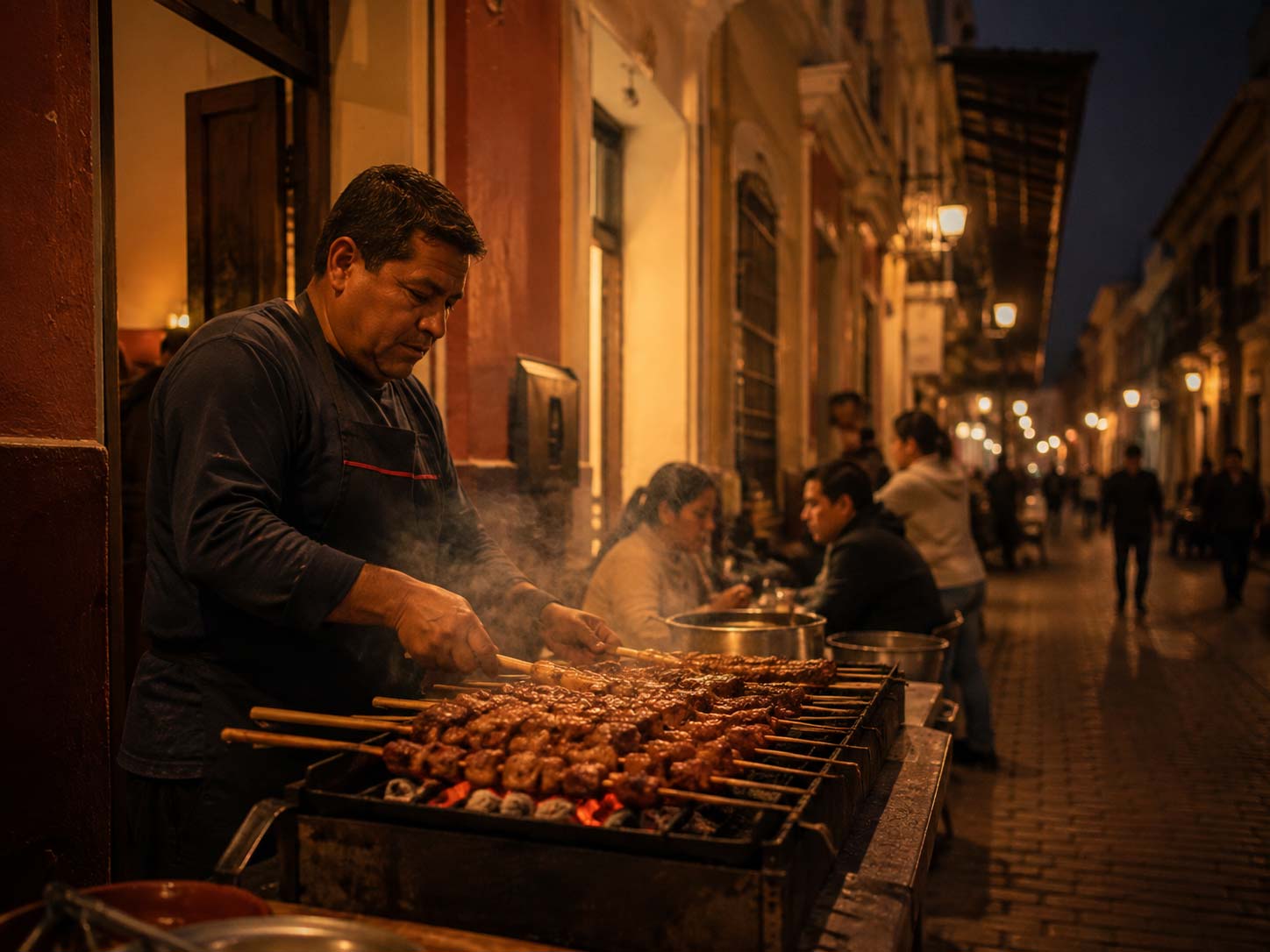
Lima has its own version of this rhythm: smoke rising from charcoal grills and anticuchos cooking over them, picarones dropped into hot oil and eaten with syrup, tamales, market breakfasts and food bought because somebody is hungry rather than because somebody has travelled across the world to document Peru’s gastronomic renaissance.
Anticuchos are especially revealing. The celebrated skewers of beef heart are tied to the African influence on Lima’s cuisine, part of a much broader history in which ingredients and cuts that might otherwise have been disregarded were transformed through technique into foods that became deeply embedded in the city’s culinary identity.
Travel north and the vocabulary changes again. Along the northern coast:Tumbes, Piura, Lambayeque and La Libertad, ceviche may be made with black shellfish, while chinguirito uses salted and dried guitarfish; chifles, seco de cabrito, seco de chabelo, arroz con pato and shámbar belong to a different landscape of warm seas, plantain, goat, maize and chicha. Outside conventional restaurants, some of these traditions continue through chicherías, where cooking may still happen over wood fire and in clay pots, and through huariques, small establishments prized precisely for something much harder to package: sabor casero, the taste of home.
The result is a culinary map of Peru that looks very different from a restaurant ranking. And perhaps a more useful one.
Because the market counter, the picantería, the anticucho grill, the huarique and the internationally recognised restaurant are not opposing categories of food. They occupy different points within the same system, relying on ingredients, techniques and cultural memory that continually move between domestic kitchens, public eating places, producers and professional chefs.
The question is not which is more authentic. The question is what each one remembers.
The distance between a potato and a tasting menu
Across Lima in Barranco, Kjolle, chef Pía León’s restaurant, approaches Peru from a different angle. Its menu is nourished by the work of Mater, the interdisciplinary research initiative exploring the biological and cultural diversity of Peru, and moves between ingredients from radically different ecosystems: corn and jora, cabuya and sacha oregano; corvina and squid with maca and mamey; scallops with nuts from Madre de Dios; yuca, olluco and other tubers; charapita chile, tarwi, muña, arracacha, cacao, copoazú and macambo. Read sequentially, the menu begins to resemble a map.
But after walking through a market, that map looks slightly different.
An ingredient does not become interesting when a chef discovers it.
Someone knew it before.
Someone knew where it grew, when it should be harvested, whether it could be eaten raw or required processing, how it reacted to heat and what it tasted like with something else. Someone may have sold it from a market stall long before it acquired the language of biodiversity on a tasting menu. Someone may have cooked it for lunch because there was nothing particularly unusual about it at all.
Long before an ingredient acquired value within contemporary gastronomy, it already possessed value within another system of knowledge.
The strongest restaurants increasingly seem conscious of this distinction. Mater’s research, for example, explicitly connects ingredients to different ecosystems and cultural environments, which makes it possible to understand the source of culinary knowledge as something that exists well beyond the walls of a restaurant.
This relationship between chef, producer and territory is arguably one of the most interesting developments in contemporary Latin American gastronomy because it complicates the old image of the chef as solitary creator. Creativity becomes less about inventing something from nothing and more about knowing how to listen, interpret and give credit to what already exists.
There is still an imbalance, of course. International attention tends to settle on the restaurant and its chef rather than on the farmer cultivating an obscure tuber, the market seller who knows when it is at its best or the community maintaining the agricultural system that allows it to exist. A crop can become internationally fashionable while its growers remain economically precarious; an ancestral technique can be presented abroad as something newly discovered simply because it is new to the person encountering it.
The question is therefore not only where an ingredient comes from, but who gets to tell its story.
A ceviche contains more people than you think
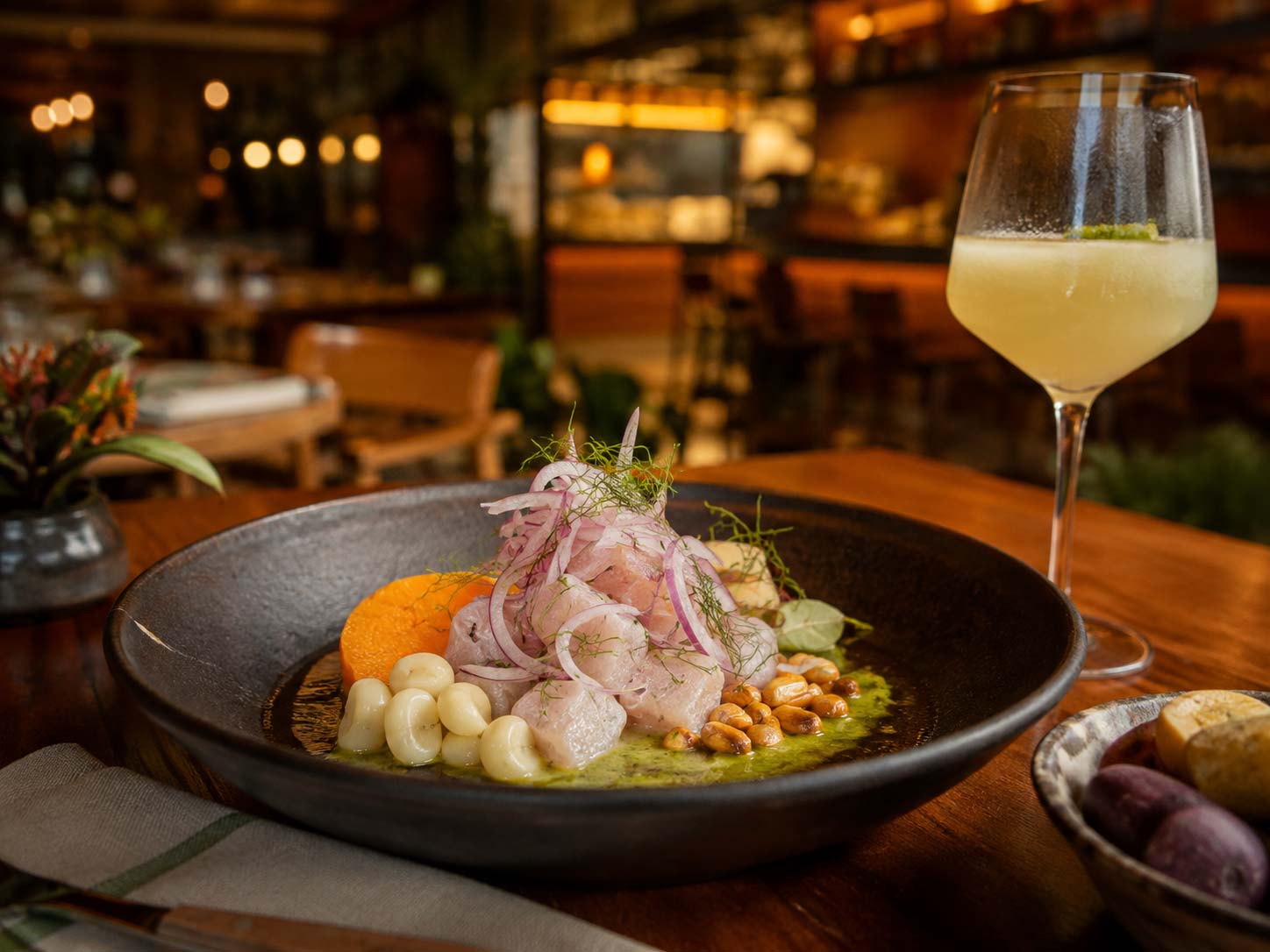
Ceviche provides perhaps the best illustration of how much human knowledge can be hidden inside something that appears wonderfully simple. Fish. Citrus. Chile. Onion. Salt.
The apparent simplicity is deceptive.
When UNESCO inscribed the practices and meanings associated with the preparation and consumption of Peruvian ceviche on its Representative List of the Intangible Cultural Heritage of Humanity in December 2023, it did not recognize a definitive recipe. The designation covers the cultural practices surrounding ceviche throughout Peru, acknowledging that ingredients, methods and meanings vary according to region.
That is a much more satisfying way to think about food heritage.
The ceviche on the table is only the final link in a chain that began somewhere else: with somebody understanding the sea, another person growing lime or ají, somebody transporting the ingredients, a vendor judging their quality and a cook knowing the precise moment when those ingredients cease to be separate things and become ceviche.
And the ceviche itself changes as the landscape changes. The version encountered in Lima does not need to be identical to the one eaten on the northern coast, just as what is available in a fishing community does not need to conform to the version presented internationally as the national standard.
At home, these skills can look almost casual. A parent teaches a child. A fisherman teaches someone younger how to read the conditions. A cook shows an assistant what the fish should feel like that morning. Yet collectively, these acts of transmission are what keep a culinary culture alive.
Knowledge does not need to be written down to be sophisticated. Sometimes it is held in muscle memory.
The women behind the regional kitchen
Nowhere is this clearer than in Peru’s picanterías and chicherías, traditional gathering places in which food, chicha and regional social life have long been intertwined.
The Peruvian Ministry of Culture has recognised picanterías and chicherías across several regions, including Lambayeque, La Libertad, Cusco, Piura and Tumbes, as part of the country’s cultural heritage, specifically highlighting them as places where traditional culinary knowledge is transmitted and where women have played a fundamental role in maintaining those traditions.
This matters because gastronomic history tends to become strangely masculine once it enters the professional restaurant.
There are named chefs, brigades, awards and rankings, whereas the domestic and community labour that preserved many of the foods subsequently celebrated by restaurants was historically performed by people whose names rarely appeared anywhere at all.
For generations, women cooked because lunch needed to be made, because a business had to open, because chicha had to ferment, because customers would arrive, because a daughter needed to learn. What we now recognise as culinary heritage frequently survived not through deliberate preservation campaigns but because somebody simply continued doing the work.
Arequipa’s picanterías make that continuity particularly visible. They connect rural traditions to urban eating and remain associated with wood-fired cooking and dishes such as rocoto, solterito and the Sunday adobo, food that belongs to a rhythm of place as much as to a collection of recipes.
The mundane nature of that labour should not diminish its cultural importance. If anything, it explains it.
A tradition that only appears for ceremonies is fragile. A tradition woven into breakfast, shopping, Sunday lunch and the places people habitually meet has a much better chance of remaining alive.
What happens when “local” becomes luxurious?
Peru’s rise as a global gastronomic destination has inevitably changed the way travellers encounter the country. A person can now arrive in Lima expecting not merely to eat well, but to encounter Peru through food, and restaurants such as Kjolle and Maido have become destinations in their own right.
There is something genuinely exciting about that. A diner who may never visit a high Andean farm can nevertheless encounter tarwi or olluco; somebody unfamiliar with Peru’s Japanese history might begin to understand it through Nikkei cuisine; an ingredient from the Amazon can provoke curiosity about an ecosystem far beyond the dining room.
But there is also a danger in turning “local” into a luxury aesthetic.
Once regional ingredients, Indigenous techniques and stories about producers become desirable, it is very easy for authenticity itself to become a form of decoration. A menu can name a community without meaningfully engaging with it. A native ingredient can appear because its unfamiliar name sounds compelling. A story about ancestry can be polished until the people within it become picturesque.
The market complicates this because its relationship to those ingredients is usually much less romantic. There, a potato is also inventory. Fruit spoils. Prices fluctuate. A cook has to sell lunch at a price people will actually pay. Somebody arrives early to secure the better produce. Tradition is not an abstract quality to be communicated to a diner; it is entangled with work, income, availability and the stubborn practicalities of feeding people every day.
Good food deserves more intellectual curiosity than the word authentic can usually provide.
If we genuinely value the relationship between food and culture, provenance should involve more than geography. We should want to know who produces something, how they know what they know, whether that knowledge is being sustained and whether the people who maintain it participate in the value being created from it.
This is particularly relevant to travel and celebrations, where there is an understandable desire to give guests a sense of place.
For a wedding or private dinner in Peru, serving something “Peruvian” need not mean constructing an anthology of recognisable national dishes. The more interesting approach might begin with the particular location: what grows there, which ingredients are in season, what people eat in the nearby market, what a local family might prepare for a celebration, whether the surrounding region has a distinct culinary tradition and which producers or cooks are already part of that story.
A wedding in the Sacred Valley should not necessarily taste like a wedding in Lima simply because both take place in Peru.
The landscape has already provided a different answer.
Nor does respecting tradition require staging it theatrically. An ancestral crop can enter a completely contemporary dish; a regional fruit can define a cocktail; a preparation associated with a grandmother’s kitchen can inspire one element of a tasting menu rather than being reproduced literally. A morning walk through San Pedro can tell a chef more about Cusco than importing a catalogue of supposedly Peruvian flavours from somewhere else.
Kjolle and Maido demonstrate, in very different ways, that roots and experimentation do not have to sit on opposite sides of the table. Markets, picanterías, huariques and family kitchens make the same argument, although nobody usually describes it that way.
The important thing is knowing where the conversation began.
The recipe after the recipe
Perhaps this is why the most compelling question about Peruvian food is not What should I eat? but Who knew how to make this before me?
It immediately changes the perspective.
A potato stops being only an ingredient and becomes evidence of generations of agricultural selection. Nikkei cooking becomes not simply the meeting of Japanese technique and Peruvian produce, but the culinary record of migration and belonging. A bowl of food in a picantería becomes part of a chain maintained, in many cases, by generations of women. Ceviche becomes not a formula but a network connecting sea, field, market, kitchen and table.
An anticucho eaten beside a charcoal grill belongs within that story just as surely as a course placed carefully in front of a diner in one of Lima’s most celebrated restaurants.
So does breakfast at San Pedro.
So does the woman in a market who reaches past one piece of fruit to give you another because she knows the second one is better.
And family cooking becomes something worth paying attention to precisely because nobody is trying to turn it into heritage while it is happening.
Someone still makes the dish because everyone likes it, someone phones an older relative to check an ingredient; someone complains that it does not taste quite the way their mother made it; someone else changes the recipe anyway. A child sits nearby and absorbs more than anybody realizes.
This is how food retains memory while remaining alive: not by freezing a recipe at some supposedly authentic moment, but by allowing knowledge to pass through people who inevitably leave their own fingerprints on it.
In Peru, some of those fingerprints now belong to internationally celebrated chefs and some belong to people whose names a diner may never know. They belong to fishing families, farmers, market sellers and picanteras; to Japanese immigrants and the generations of Peruvians who followed them; to the person turning anticuchos over a charcoal grill, the cook ladling soup into bowls at a market counter, mothers who cook by instinct and children who do not yet realise they are learning.
There is an intimacy in that chain which has very little to do with fine dining and everything to do with why we feed one another in the first place.
Food can carry history because it has to be made again and again. Each time, somebody has to remember what to do.
And, before they could remember it, someone had to teach them.


